Monday, October 28, 2024

Trying New Rules

 This actually was yesterday


We tried out the latest edition of Black Powder.  In the final analysis it was a bit too complex with little reward for the effort.


Stutz Holds the Ridge

This Was Not Yesterday (8 October 2014)


Wednesday, September 10, 2014

Painting is a soothing activity for a winter evening

So I think I will get back to it.  I have a large block of primed Pendraken Austrians.  I think I will take them along with my British guns and form up a new fraction.  I am fond of a blue-grey not far from RAF Blue  so that will be the dominant uniform color, with the usual variations for Gentleman Cavalry and the like.  Should be fun, and soothing stuff to paint.

Friday, August 3, 2012

Primed Pipeline

I have been on an inventory and planning kick of late.  In that spirit, here is an inventory of my figures for this project, organized by battalions and regiments.  These figures are all base-coated and good to go.

I know I am coming back to this list,  bacause I know that I have recently primed some figures I can't find.  But this is most of them.

Style Line Grenadiers LI HC Dragoons Hussars Guns Howitzer
Brit 4 1

1
2
Prussian 1

1 3 1
1
Austrian 5
1
1 1
1
French

2 2


 In addition, there are some not-yet-organized bits and pieces.


Mounted Leaders 3
Mounted Brigadiers 9
Dismounted Brig 2
Engineers 16
Nobles 6
Carriage 1
Siege Mortars  2


This is over 300 foot and almost 100 horse; probably another 60 figures beyond that.  Counting hoses and guns at 2 points, this is the equivalent of painting about 600 foot.

Should be good fun.


Monday, June 18, 2012

Supplies for Stutz

The Bravantois siege of Sutz is in its fourth week, and supplies are short.  Drakenburg has dispatched a supply column, escorted by a line infantry regiment, grenzers, and two regiments of horse.

As they are approach the fortress, they are surprised by a Bravantois battalion, responding rapidly to the alarm.


But they receive a poor reward for their promptness; the hussars and the lead battalion put paid to them rapidly.

An auspicious beginning for Drakenburg forces.
 But the column does not go far before fresh threats are perceived on the right -- jaegers backed up by line infantry.


The cavalry moves to cover, while the column plans to divert by the road farthest from he threat.  The wagons will never manage cross country.
But as the advance moves around and prepares to climb the last hill before the fortress a Bravantois battalion that has crept to edge of the forest near the road charges out from ambush, hitting both the march column and the wagon train.
The wagoners run for their lives, while the undeployed infantry column, disordered by the attack, falls back to regroup.  But, to add insult to injury, fresh Bravanois cavalry have smashed the covering Drakenburg horse, and now pile on to the struggling infantry.


 Soon the situation for the column is quite untenable.
While the grenzers who have slipped past the enemy and raced away for help are too late; that small force is the sole aid the garrison receives.  Nevertheless, the siege continues.


******
Technical details on my root blog.

Friday, May 11, 2012

Origins

Drakenburg Palace, May 1747.

The origin of the aboriginal human inhabitants of the islands of New Jerusalem was discussed at the spring meeting of the Drakenburg Acadamy Of Sciences.  The two leading theories are original settlement by the Lost Tribes of Israel, and by survivors from Atlantis. 

Discussion rapidly became heated, and we are sorry to report that the meeting was adjourned without a final settlement of the matter under discussion.  Followers of natural philosophy will, on the other hand, doubtless be delighted to learn that Professor von Sauerwitz is expected to make a full recovery from his wounds.

Saturday, May 5, 2012

Population, Pre-History, and a Lost Continent

Just playing with a few ideas:
  • Total population in 1750 is far less than Europe's - say about 40 million as opposed to about 120 million for Europe.
  • Our seed European population in the 1170s is a couple of thousand, of which only a couple of hundred are nobility..
    • but including a wide range of trades and skills.  Clearly, their original plan included some aspect of colonization.
    •  and aware of iron production and three-crop rotation.
  •  There is a base population on the island; exactly the size I will have to work out
    • Bronze age technology
    • but superlative sanitation in their near-abandoned ancient cities.
    • and major domestic animals along with the rest of the  fertile crescent crop package, especially wheat.
  • The local nobility is rapidly displaced (and merged) with the European
    • agricultural yields go up with improved crop rotation and iron-shod plows.
    • the excellent sanitation is adopted with enthusiasm by the Europeans
    • leading to a burst of population growth, although probably still with a preindustrial population curve. 
Geographically, I am thinking of a substantial landmass of varied geography  surrounded by something of an archipelago.  Many would be obvious former volcanic calderas, such as scaled up versions of this small Hawaiian island with fertile areas generated by extended erosion. This lets us have significant Naval operations; but still the area we have is large enough that some at least would be isolated from maritime interference.

Friday, May 4, 2012

Windows and Places

Here's a place where we can deposit our Utopia.  The Kingdom of Jerusalem controlled Aquaba from early in the 12th century through to about 1187.  We can imagine our Europeans departing somewhere in the 1150s, perhaps deciding to escape the civil war that afflicted the kingdom of that time.

The Portuguese began to explore our little corner of the Indian ocean in the 1530s.  That gives us around 350 years for initial development of our little community, and a further 200 from that rediscovery until our period of interest; a bit longer before the expansion of exploration makes discovery unavoidable later in the 18th century.


Records from the middle ages are scant enough to allow the disappearance of hundreds or even thousands of people to go unnoticed.  We can put the last 200 years down to the work of the Society of New Jerusalem.  The early explorers who returned to report small desert islands in the area came back wealthy -- and carefully watched -- men.

Saturday, April 28, 2012

Scales of Imagining

I am weighing two choices in imagination creation - lets call them the large scale approach and the small scale approach.  

The small scale approach is the traditional old-school wargaming method for fighting "age of reason" battles without being bound to actual history.  Since the territory of the Holy Roman Empire was filled with small states it is a small step to co-opt a small bit of generic German geography and place the imagined states within it.  In most maps I have seen the geopolitics are rather distorted - while conceptually the states are small, the armies they deploy and extent of their territories would really be significant in the mid 18th century.

The big plus of the small scale solution is that it allows the inclusion of historical states and the extended political context of the 1750s.

To my mind the big minuses are
  1. It requires large scale distortions to include naval operations.
  2. If I want to go beyond the conventional confines of 18th century gaming to include colonial or fantasy elements then conventional Europe is in the scuppers altogether.
The large scale approach is a bit bolder.  Of course,  fantasy maps from Middle-Earth  to Westros have left us accustomed to imagined geographies resonant with our real world but with their own cultures and technology; however I also want a somewhat "firmer" rooting in the real world; not very firm, but the sort of mix of silly and plausible that sets hoaxes like the da'Vinci code, Chariots of the Gods, and vikings in Minnesota in the human imagination.

My idea for a large scale approach is to "create" a landmass in the Indian Ocean centering a bit north and east of the French Kerguelen Islands.  The relic of lost Lemuria "was" discovered by a party of European crusaders of many nations attempting to find and recruit Prester John to their cause.  They conquered and converted the natives, founded their own kingdoms, and prospered.  They have never actually lost contact with Europe, sending their sons to Europe to study.  Considering themselves as Europeans, they follow the latest trends of their parent nations with great dedication; the latest fashions and books from Paris are to be found in the new land sometimes before they reach some parts of Russia.

With that approach, I can include naval warfare, lace punk, elephants, Indians, and even ancient forces of lost Lemuria deeply inimical to the progress of man.  It's a stretch, but then it is just a search for a fun context in which to place a gaming environment.

Thursday, April 26, 2012

What is needed for war...

... is money, money, and more money.


I like a campaign to reflect as much as possible the flavor of he period.  For some periods, and some places, that makes finance a key component of the game.  How can one game the rise of the Italian city-states, for example, without considering bankers and finance a key element?

So, what do we need to cover to capture finance in the 1740s and 50s?  It's a complex period - Bank of England, stock market bubbles, stock exchanges.

So I turned to an old standby, The Fontana Economic History of Europe, edited by Carlo Cipolla and published in the early 1970s.  While I am sure that there has been a lot of development in economic history  since, it is still solid scholarship that hits the high points.  Volume two, The Sixteenth and Seventeenth Century (Collins/Fontana, Glasgow, 1973) includes "The Emergence of Modern Finance in Europe 1500-1730"  (Geoffry Parker; pp.527-589) .  While it discusses the more advanced economies, the last paragraph gives us our default position for our small backwater states:

In many areas, even in 1730 ... public finance was still confined within the straightjacket of anticipations and tax-farming.
 Both methods are basically the sale of futures on government revenue for cash up front.  Anticipation is the sale of a particular revenue (say, a salt tax) until principal and interested are paid.  Anticipated revenue is collected by government officials but remitted to the financiers.  Tax farming is complete outsourcing of taxation; the farmer pays for the right to collect taxes according to rules set by the government.  (If you ever wondered why tax collectors were so hated by the people of the New Testament, consider that they were probably subordinate tax farmers who had paid for the privilege of putting the squeeze on their neighbors).

On the income side, we have to remember that "contributions" were also still levied on captured territories -- Frederick squeezed Saxony for every pfennig -- and that if we want to consider possible interference by the great powers British subsidies might well be sent to counterbalance French soldiers. 

That's a simple enough framework for pretty simple basic annual income rules, but does not bring that much flavor.  Volume four of the series is The Industrial Revolution  and it includes "The State and the Industrial Revolution" (Barry Supple; pp. 301-357).  Supple remind us of the state projects of various "Enlightened Monarchs" such as Frederick and Maria Theresa in establishing factories and various other enterprise designed to make their principalities wealthier and less dependent on imports.

It is important to give sovereigns reasons to spend their money besides war.  Royal palaces, grand entertainments, and a collection of artists, musicians and philosophers all contribute to reputation and influence wavering allies; as does a careful caress of gold in the palms of the appropriate councilors.

We shall consider how this would fit into a game in another post.  Early days, as well, and more research needed.

Friday, December 30, 2011

Preliminary Map

Of my little corner of not-Germany.  This is the political map; I am adding a point-movement system to this that will incorporate the geography.

Monday, December 12, 2011

Campaign Thoughts

There's nothing like a fun game to get one thinking about a PBEM campaign.  Rob has shouldered the burden for a couple of long-running Diplomacy campaigns and it would be nice to take my turn a bit. 

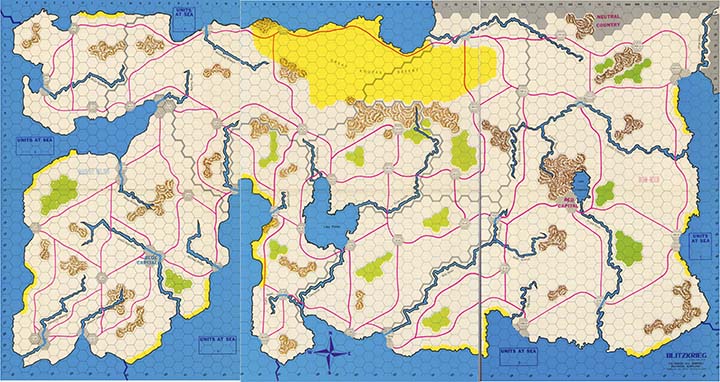
The basic plan would be to create an Imagi-Nations map -- perhaps using the method published by Henry Hyde for the Faltenian Succession (See Battlegames 4), perhaps using a separate continent based on something like the Blitzkrieg map -- with 3 major powers (Drakenburg, Bravant and Stuz-Berkatz) and 4-6 minors.  Players would submit orders every couple of weeks and I would adjudicate, resolve battles solo and communicate results.  The backbone would probably be the rules from Battlegames with a very few twists.

Since the players would be scattered around the country -- or further -- a lot of interest would have to be in the intrigue and the operational campaigning rather than in the battles themselves.  In fact, as long as the players have fun it would not actually bother me if no-one fought a battle.

I will have to mine the literature for examples of intrigue and dirty tricks -- I watched a documentary on Catherine the Great last night which certainly left me with an impression of  Enlightenment politics as a full contact sport.

I would value thoughts on this from all and sundry.

Saturday, December 3, 2011

Battle of the Bridges

Control of the vital road junction of Dreibrücken is a critical step in a successful advance by Bravantois forces against the Landgaviate of Stutz-Berkatz.

Today, the armies of the Duke of Bravant, under the command of the duke himself advised by Marshall MacDuff attempted to seize the bridges.   They were opposed by the combined field forces of the Landgave and the Archduke of Drakenburg.


The Allied avaunt-guard stole an early march on the enemy, and began to secure the left bank.  The famed Darkenburg Hussars were backed up by the Fenwick Light Dragoons, the Drakenburg Croats, the Fenwick Fusiliers, and every battalion gun that could be pried from the Drakenburg army.

In passing, we note that the Fenwickers do not consider themselves to be mercenaries, preferring instead to think of their lord as a nobleman with a fixed loyalty to profit.


A short while later, the first brigade of Branvantois horse made their way on to the right bank.


Soon thereafter, the Drakenburg horse on the extreme allied right met the second Branvatois cavalry brigade on the Branvantois left.


While the Stutz-Berkatz horse deployed to face the waiting enemy in the centre.


Seeing their chance, the Drakenburg horse got "stuck-in" and began the destruction of the Bravantois cavalry.
A decision fulfilled by the charge of the Stutz-Berkatz horse in the centre, leaving Marshall MacDuff struggling to rescue his shattered regiments.


But the tramp of marching feet was soon heard, as the cavalry preliminaries were concluded and the main bodies of infantry began to enter on both sides.  The Bravantois cavalry had been driven from the field; the Stutz-Berkatz cavalry had suffered in the engagement and fell back in the centre effectively spent.  The Drakenburg cavalry, victorious but exhausted, deployed to threaten the Bravantois left.

The Branavtois avaunt-guard held the right bank of the bridge nearest its entry point, matched and engaged in a long range fire-fight with their Allied opposite number.  In the centre a strong brigade of infantry backed by heavy guns threatened the middle bridge facing a weak Stutz-Berkatz brigade and supported by a brigade composed of the Bravantois Guarde backed up by French-supplied Swiss and Scots.


The Bravanois forces shook out into line and began to advance.  Long range fire from the battalion guns forced the exhausted Stutz cavalry to retire.


The Drakanburg contingent, meanwhile, has occupied a position in a large farm complex on the right and established a battery to bombard the enemy centre.  The Branavtois infantry on their left are likewise holed up, but with a single battalion gun are as good as neutralized far from the objectives.


The Branvatois try a strong two-brigade push in the centre, but it all goes horribly wrong.  First, in a surprise success so rapid it is almost missed the Berkatz "double-blue" freikorps send a Branvois brigade packing with losses; only a second attack drives it back.  Then the much-vaunted guarde refused to advance.  This unit is amazingly consistent in its behavior. Marshall MacDuff attests that they have failed him in every engagement in which he has employed them,and believes they should be rated as a militia regiment for spoiled noblemen's distaff offspring.


Meanwhile, the Stutz-Berkatz first brigade arrived on the left bank, and secured the left bank of all the bridges.


With the centre brigades broken or compromised, night falling, and a frech Drakenburg force advancing, Marshall MacDuff realized that he could neither secure both banks of any bridge, nor even force a draw, and so elected to withdraw from the field.  With their cavalry blown and one enemy brigade untouched, the Allies elected not to push the pursuit.


 ****************************************************
The game was played  using Ross's (MacDuff's) Hearts of Tin rules, the latest version of which can be found from his Battlegame of the Month blog.  In the past we have translated inched to centimeters since Ross's rules were originally designed with 20-40mm figures in mind.  Today we used inches straight up; so foot was moving 9" in line and horse 18"; guns reached out 36".  These are bloody rules, since battalion level morale results are simply rolled into losses.  Fast movement, long ranges and bloody combat makes a fast decisive game with a short cycle from decision to combat to result.  This was not a small game - something like 20 or so units on each side - and came to a sold conclusion in 12 turns over about 4 hours (leaving out the coffee and lunch breaks).

And the Brantois Guarde  really is that consistent.

All figures are Pendraken.

Saturday, September 10, 2011

Bravantois Horse

The heavy horse of the Duke of Bravant.

First, the Gensdarmes of the Guard, led by their colonel-in-chief General Epinoy


Red with yellow (gold for officers of course) turnbacks.  Bays, except the trumpeter on a grey.

Next in precedence, the Regiment St. Laurent. 


Finally, Regiment St. Urbain.


Yes, they are "Saint Urbain's Horsemen" -- I never could resist a bad pun.  And yes, St. Laurent ("La Main") is also a Montreal street.

I also really like their commander, who is from one of Pendraken's commander's singles.

Sunday, August 7, 2011

Bravantois Artillery

The senior engineer inspects Batteries Gagnon and Tremblay.


Gunners often shed coats and hats, showing their red waistcoats and  breeches.

All artillery wear a dark blue coat with yellow cuffs; hat trim is white.

Sunday, July 31, 2011

The Duke of Bravant

Bravant is the most French influenced of the imagined enlightenment states.  It also, at this moment, has the strongest army.

 Here the duke (Francois III)  himself inspects the drill  of the Lachine regiment.


The Lachine uniform is in the French style, with a coat of unbleached wool, and pale blue turnbacks, yellow trim on the tricorns.